I try to be really careful on this blog to avoid politics. It’s not that I don’t have political convictions; it’s just that politics is polarizing, and all I want to do here is to share and support.
So please understand that I’m not taking a political stance saying what I’m saying here. I simply cannot stand by and see this happen.
It is never acceptable to mock someone’s struggle with substance misuse. It’s even less acceptable to weaponize the struggles of a son against his father.
Addiction doesn’t exist in a vacuum. Rather, substance misuse is most often the manifestation of other issues – underlying mental illness, trauma, brain injury. Identifying and treating these issues themselves takes patience, compassion, support and resources.
Addiction is not a character flaw; it’s a flawed coping mechanism. Addiction affects 21 million Americans, yet only 10% receive treatment. Addiction causes immeasurable pain to loved ones.
Roughly 20% of Americans who have depression or an anxiety disorder also have a substance use disorder.
Ignorance and mean-spiritedness accomplish nothing. Rather, we need to educate ourselves. We need to find compassion for each other. We need to do better.
…or the lack thereof has been at the forefront of my mind lately. I was listening to a podcast during one of my lengthy walks, and a line struck me, something about the fact that difficulty tolerating uncertainty is one of the hallmarks of anxiety. It describes me all too well.
I’m racked with anxiety every day. A great deal of it is job insecurity – I don’t know what’s going to happen with my industry – and I can only assume that getting back to the level of work that I had pre-pandemic will take years, if it ever returns. It’s a hard pill to swallow.
(And don’t get me started about the uncertainty surrounding November 3.)
There is a grinding nature to chronic anxiety; I know the feeling too well. I spent years and years feeling like this every. Single. Day. For weeks, for months. When people learn about my long-standing mental health struggles, they always express surprise – I always look like I have my life in order! I tell the that I’m a high-functioning mess.
I suppose I make light of it because I don’t want anyone else to feel burdened the way I’ve felt burdened, but the truth is that sometimes it hurts a little to think about it. The fact that I was able to build my career and have a life despite the generalized anxiety disorder/major depression/minor mania/undiagnosed bipolar is a testament to discipline. It’s just that I can’t help but wonder what I could have done if 80% of my energy wasn’t sucked up by managing and mitigating my mental health. What would life have looked like, what would it look like now?
Thankfully, I’ve been in a place now for a few years where the worst of the depression and anxiety are largely muted, and I remembered what it was like to feel “normal”. So I suppose the meager silver lining of Covid-19 is that it wasn’t Covid-17, because I don’t know how I would have coped. As it is, I’ve been relying on my rediscovered sense of “normal” to keep me vigilant of when anxiety and depression begin their dangerous dance.
These continue to be bewilderingly painful times. Anxiety and depression are touching those who have never previously experienced mental health crises. And for those of us who have been in the trenches for many years – I ache for you, my friends. Mindfulness, social interaction, focusing on the present, good nutrition good sleep, good exercise. Easier said than done, I know. But I’m trying, and I hope that gives you the energy to keep trying as well. I support you. And that, at least, is something I can say with certainty.
That America’s dividedness has become a prominent topic of discussion is evident. And it’s probably a good thing. But somehow I feel this is wrought with misunderstanding, and that lies in the assumption that division – our “otherness” to each other – is somehow a new development.
It has always been there, my friends, it just hasn’t been at the forefront of the national psyche, forced there by the events of this summer (brought into agonizingly sharp relief by the murder of George Floyd) and the daily onslaught of crude, inflammatory rhetoric from those who should be uniting us (this needs no explanation). And so people tend to retreat to their corners, operating under the safety of the company of others who share the same label.
Labels are interesting. They shift, go in and out of acceptance, change as those who suffered under an external label strive to self-identify. And this self-determination inspires me; everyone should be called what they want to be called.
Then there are other labels that are imposed. Not what we want, but what they want.
The sign of a woke person in this day and age is to be up on your acceptable labels. Latinx, for example. Inclusive, gender neutral. Ok great. But do people seem to care that, as of a 2019 Pew Research Center study, less than a quarter of those who identify as Hispanic or Latino have heard of this term? And that only 3% would label themselves Latinx? Is it perhaps a label that serves the labelers more than the label?
Then there’s BIPOC. For those of you who’ve not yet encountered this term, it’s an acronym for Black, Indigenous and People of Color. Advocates of this label argue that Black and Indigenous people have suffered and continue to suffer disproportionate injustice in the US, an observation with which I would absolutely agree.
But then there is the big lump of us POCs – Asian, Pacific Islander…Latinx. Each with our individual experiences of prejudice and discrimination, huddled together under the same umbrella. I understand the desire to simplify an acronym, and the challenge of finding terminology to be as inclusive as possible, but…
And then, did you know that the US Census Bureau considers people from Southwest Asia, the Middle East or North Africa to be “white”?
I’m going to let you chew on that for a while.
And then there’s the whole notion that BIPOC represents everyone who is non-white. I realize that this is a distinction meant to point out both the white majority and the history of white privilege. BIPOC has an implication of “otherness”.
Did you know the that very same US Census Bureau projects that by 2045 white Americans will no longer be the majority, but will become “minority white”? Do they then become NPOCs – Not Persons of Color?
I don’t mean to add instigation to a topic that already stirs up emotion, but I think these conversations are important. And labels attempt to simplify the complex, because it’s easier for us to consider a person by their label rather than the complicated amalgam of race and culture and language and self-identification that makes a human whole.
I, for instance, am half Asian. Growing up in Hawaii, that literal melting pot, I was largely shielded from labels. But when I moved to The Mainland (what we called the continental US) for college, I became acutely aware of my “otherness”. And the fact that I’m not one identifiable race makes my case even more complicated – I defied labels, and that sometimes made people unsure how to approach me.
And I’m not going into the challenge of being a (half) Asian woman and the cultural baggage that carries, because that’s a whole discussion in itself.
This is all to say that labels attempt to simplify, and while that may be fine for efficiencies’ sake, we cannot, must not, forget the nuances. Indigenous people have suffered horrors that are different from the horrors of Black history in America. Latinx (yes, I know, I’m using a label that I have conflicted feelings about, but, hey, as I said, the uncomfortable compromise of efficiency…) face their unique discrimination, and the growing xenophobia aimed at Asian-Americans is quite frankly frightening (I’m telling you, if I hear “kung-flu” one more time, I may be thrown into an uncharacteristic rage).
And I will leave you with this; my mother is Japanese, and my father was an American mutt – grandparents on one side emigrated from England, and the other side is French and can be traced nearly to the Revolution. I have always danced between those two identities, even as a majority who look at me would label me Asian. Whenever I fill out any government forms I check “other”, because nothing applies to me.
That same Pew Research Center study I referenced above shows that “mixed race” will constitute 4% of the population come 2045.
Maybe I’ll have a label then.
But until then, I suppose the important takeaways are: be aware of what you call people. Those very labels can influence the way you feel about them. Be aware of what people want to be called. Because those labels influence the way they feel about themselves. We are all unified both in the uniqueness of our experiences, and by the similarities in our experiences. The answers aren’t easy. Let’s just keep asking questions, of ourselves, and of each other.
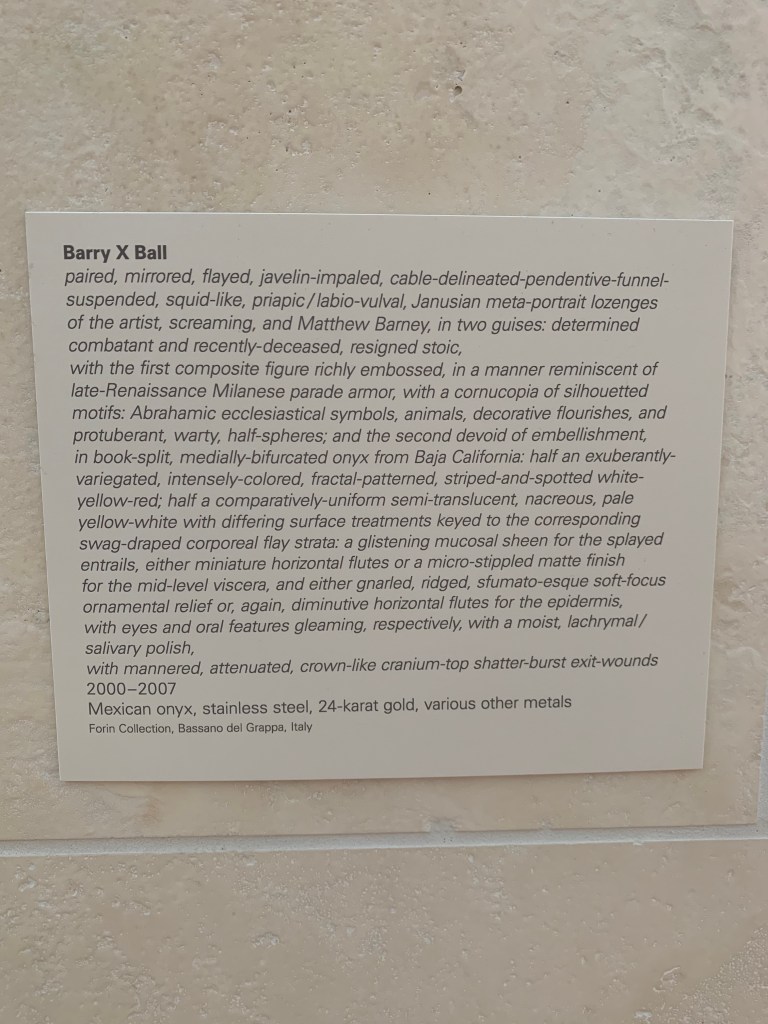
The extraordinary label/title that artist Barry X Ball gave to one of his sculptures
I came out as bipolar to both my colleagues and an audience of 1,800 at a concert that I curated about music and the mind.
Covid struck, erasing 6 months of work and plunging my industry into chaos and an uncertain future.
I washed my hands. A lot.
As the primary breadwinner or the family, said erasing of work plunged my family into financial uncertainty.
I spent a lot of time in bed, reading news on my iPad and trying not to throw up from anxiety.
I ran. A lot.
I bought a ring light, signed up for Canva, set up my mic, pulled out my keyboard, mastered iMovie and taught myself how to be me in a totally different way.
I helped create one of the earliest virtual orchestra projects at the beginning of lockdown.
Pinkerton sustained a traumatic spinal injury in a freak accident – my amazing friends set up a GoFundMe to pay for the heart-stoppingly expensive surgery.
I cried. A lot.
I celebrated my 20th wedding anniversary.
I connected more frequently with friends far away, through Zoom and Marco Polo and texts and old fashioned phone calls.
I connected more frequently with friends close by, through weekly walks, socially distanced hikes and outdoor happy hours.
I brought groceries to our elderly neighbors and checked up on immunocompromised friends and worried endlessly over the health of our parents.
We ran some financial projections and came to the realization that we could no longer to afford our apartment – 5 days later we signed a lease on a new place, and 2 weeks after that we moved.
I continued to run. A lot.
The unexpected unemployment gave me ample time to really flesh out some vague ideas I’d kept in the back of my mind – the skills I’d learned allowed me to create a vibrant presentation – I’m developing a project with some really creative people that may take my life in a new direction.
In another unexpected twist, I was brought on board to host TV broadcast/livestreams of live concerts by the Minnesota Orchestra.
I reflected on my life. A lot.
You could look at this all in different ways. On one had, the pandemic is a shattering disruption to life. On the other, it’s a universal pause and, hopefully, a reset. I’ve never been so anxious and depressed in my entire life (and I’ve been through more than most). I’ve also never felt so grounded in compassion and connection.
If you added everything up, the good, the bad, the ugly, it may be a zero-sum game. But right now that very neutrality is allowing me the footing to move forward, in directions I never thought I’d travel, and in the work of being myself. I’ll keep seeing where it takes me.
San Francisco looked like Mars last week. This was 9:30 am. It got even weirder at noon – darker, more oppressive – but I couldn’t bring myself to go outside. It was just too upsetting.
Between the pandemic, the 5 Atlantic cyclones, the record-setting conflagrations, the red skies, the plague of locusts (yes, there was one in Africa)… I have to fight the rising anxiety that we’ve entered end times.
In the mean time, I’m working on projects, conducting concerts, beginning my TV hosting career, moving forward in the ways that I can.
Hold your loved ones close, find the beauty of small things, and let’s keep breathing (with the air filter running, of course…)
Today is World Suicide Prevention Day. As far as I’m concerned, every day should be World Suicide Prevention Day.
For those of you who don’t know, I am a survivor of suicide. For those of you not up on the lingo, this does not mean that I survived a suicide attempt; rather it does mean that I’ve survived the suicide of a loved one.
My dad took his life in 2001, and it was a life-defining event. I wrote more extensively about it on my other blog, and I’m going to attach that post to this one, because, even two years out, it accurately captures all of the complex thoughts and emotions that surround his death.
A suicide in the family changes you, changes your family, changes what you imagine is possible in the universe. It’s an ache that may wax and wane, but will never recede. The anger, the anguish, the self-recrimination – you learn how to lean into them, to find adaptive coping mechanisms, to learn how to keep living. I have. And I’ve learned that life can hold beauty and wonder despite the permanence of pain.
My father took his life on March 28, 2001. Dad was 60, a highly respected lawyer, in good health, with a wife of 33 years and two grown children. I had just gotten married the year previous – my brother had settled in San Francisco and was establishing his life. From all outward appearances, things seemed to be going well.
The public face never tells the full story of course. Dad had always had a depressive streak, something I began to notice in my teens. His way out of it was what felt like a forced manic extroversion; he was the life of the party, the most lavish gift-giver, planner of extravagant trips, the loudest laugher at any gathering. He strove to be larger-than-life. He was adored by his friends and clients and acquaintances alike.
My relationship with him was far more complicated, a tale for another time. Suffice it to say that seven months after my wedding I realized that I needed to work through my complex feelings about him, and I needed some space to do it. I asked Dad to give me some time to figure some things out for myself, and that I would be in touch with him when I felt ready.
Three months later he was gone.
It’s taken me many years and a bank-breaking amount of therapy to come to a place where I can accept that my actions were not the cause of his suicide (it didn’t help that he jumped with a picture of me in his pocket). It may have been the proverbial straw that broke the camel’s back, but the reasons were probably many. The torture for those of us who survive a loved one’s suicide is that we will never know, and part of the pain of their death is living with that uncertainty, and being able to accept that there will never be an answer.
I’ve also come to understand that my feelings about Dad and his death will never really be resolved. Seventeen years later I still have my moments of absolute grief, or uncontrollable anger, or utter confusion. I know that for me the best thing to do is to sit with those feelings, allow myself to feel them, to not judge myself for feeling so conflicted, and to seek out support, whether from friends or from a professional.
Most essays and articles on the subject of suicide end with numbers for prevention hotlines, how to ask for help, how it is avoidable with the right intervention and support. It seems like little is said to those who are left behind, those whose lives are torn apart, those who must live forever with the reality of an avoidable loss. It is we who blame ourselves for not seeing the signs, for not being able to help.
To us survivors I say this; we’re all doing the best we can in a complex and uncertain world. Some have made the decision that they are no longer able to make their way in it. We can only be accountable for ourselves and our own actions. The best we can do is to direct the tenderness of our broken hearts out into the world, knowing that the kindness that arises when the grief finally softens can bring healing not just to ourselves, but to those around us.
Although, with time and healing, we can move through those initial feelings, know that they will always be there. The challenge is to neither let our loss be that which defines who we are, or to push it below the surface in hopes that the pain will go away. The suicide of a loved one is an inextricable part of our experience, part of the intricate tapestries of our lives.
And we must remind ourselves that the resurgence of grief is to be expected, and that the sometimes overwhelming and overwhelmingly complex emotions we feel are simply part of the human condition. When it becomes too much, reach outward, because connection, too, is a part of the human condition. Support and love will be there.
Finally, let us be gentle with ourselves. Let us remember to see the small, beautiful things around us daily. Let us allow our compassion to guide us. Let us hold our own hearts softly, like a newborn. Let us be well.
Sanitized TV remote, Marriott Downton DallasSanitation station outside elevator on every floor, Marriott Downtown DallasDaily wristbands indicating that I’ve passed a temperature test, Meyerson Symphony CenterHand sanitizer with logo, Meyerson Symphony Center
You might ask why the title, seeing that I’m in Dallas.
One has all kinds of curiosities when one has been away for so, so long from a life-defining activity. Will it feel strange to be back onstage? What will it be like to face that rush of sound and information? How will my mind, my ears, my body react?
But the minute I step on the podium, clarity dispels all concerns. I’m home, in the most comfortable place I’ll ever be.
Many people ask me how I get booked for gigs. Until yesterday I would have said that I am managed by Columbia Artists, one of the oldest and most prestigious classical music agencies in the US. Well, no longer, CAMI is shutting down.
It’s pretty devastating, and a huge blow to all the artists who were represented by the company. And it has sent a wave of anxiety throughout the industry – if one of the biggest can fail, can everyone else be far behind?
I’m devastated. I had an incredible team working with me.
So, yet another thing to deal with in the midst of a pandemic. Hope you are having a better week.



 Coronavirus Diary: Mental Health in a strange new world