It’s hard to be a performer who’s no performing. For those of us who perform for a living, it very much becomes a part of us, a fundamental way in which we interact with the world, and find our place in it. Performing, sharing, connecting – this is an essential part of who we are.
Many of my colleagues in the music business are finding their own way to continue growing during this time of isolation. Everyone processes fear and grief and frustration in their own way, and my friends have found a multitude of approaches to continue to express their unique points of view.
My friend Elena Urioste and her husband Tom Poster have found a way to cope together, and to find peace with the world, by putting together incredible arrangements for violin and piano. Elena is a beautiful player and a beautiful soul, and it all comes through in her music-making, even if the source material at hand is “Baby Shark”. I hope to post more regularly about how musicians and artists are dealing with the current state of the world, and I could’t think of a better place to start.
I started this blog as a response to the shelter in place mandate placed on my hometown of San Francisco 21 days ago, on March 16. My initial thought was to use this as a space to both express myself and connect to others through a period of unknown, and my hope then was to end this exercise after 21 entries, when a semblance of normal life might return.
Clearly that has not been the case.
Current mood
I wrote about discipline yesterday, and it has been much on my mind. When the external requirements of everyday life are removed – work, travel, gym, socializing – it’s too easy to get lost in the inertia of quarantine, the hours loose and disorganized. Like many with type A personalities, I do well with structure and deadlines and accountability. The amorphous creep of days in our isolation has been doubly challenging for me.
While I do have work to accomplish on a daily basis (at least for now, until my various projects on contract are complete), the challenge has been to create a schedule for my days that gave my days enough of a framework that wouldn’t revert to default and spend all of my time curled up in bed. And while I’ve found the things that give my days purpose – running, walking my dog, making sure family is doing okay, connecting to friends – this blog has given me a daily responsibility.
And so, while I had fully intended to go on hiatus after the first 21, it makes sense for me to continue for the next 21.
How do you adjust when plans change? Do you immediately jump to the new situations or do you experience resistance?
My task today: put on some makeup and do my hair. I find it’s easier to feel like I have my shit together when I’m put together, and I need that right now (done!)
Orderly of prescribed conduct or pattern of behavios
Self-control
Today, Queen Elizabeth II appealed to her nation for self-discipline and resolve today in a rare televised address. If you haven’t heard it, I strongly urge you to do so:
“Discipline” is not a popular word in the States. It denotes both punishment and constraint from personal freedom. And while I deeply admire the “can-do” spirit of the country of my citizenship, I’m often at odds with the notion that sacrificing more immediate pleasures for the sake of the future, or that basing personal action on a sober overview of the larger picture strips us of our freedom or dominion.
I like that “discipline” carries with it a whole host of both positive and negative connotations, that its definition depends on use and context. For me, its implication is nearly universally positive.
I believe in discipline. Because it helps me get things done. Because it gets me up in the morning. Because a sense of discipline and duty creates a purpose for the self, a powerful motivator. Because it has brought be back to my computer, day after day, to write a post, as I promised myself I would.
What does discipline mean to you?
My task today: go on a socially-distanced walk with my friend Lilly. I knew today would be rainy and we’d be unenthused, but that it would be good for both of our spirits (done!)
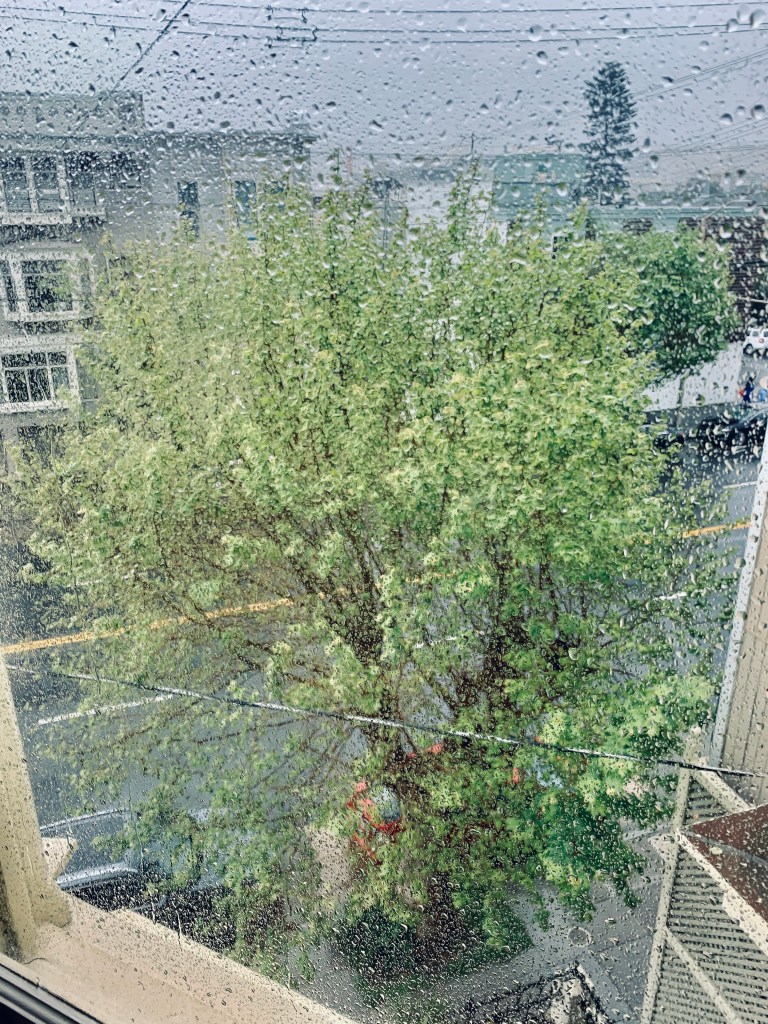
It’s a gloomy Saturday, all chilling drizzle and slate-grey skies, the sodden swish of cars driving past my window. As one who has a tendency towards depression (even though it’s currently being well-managed medically), I’m particularly mindful of days like today, where it would be easy enough to slip into the dreary melancholy that seems to saturate everything around me.
I’ve learned to combat the inhospitable with the comfortable – by creating an environment of hygge. My Danish friends acquainted me with the concept before it became a cultural buzzword here in the States a few years back. If that was off your radar, a brief explanation: hygge is a word that doesn’t have a direct English translation, but the closest is “coziness”. It’s a sense of quiet contentment and comfort and well-being, usually shared with others.
Some hygge-inducing activities include slipping into soft clothing, sipping a warm drink, and lighting a fire or a candle. If you’re taking it to full-on Danish levels, it could also be about hand knit socks and cardamom buns, but you don’t need to go so far. It’s basically about taking pleasure in small, simple, soothing things.
Americans, in aggregate, are not so good with small things – it’s part of the “go big or go home” ethos of this country that can cut both ways; it can lead to great accomplishments but at the same time makes us particularly unattuned to the less obvious (and often equally wonderful) things in life. Hygge asks us to step back from trying to make a larger statement or to assume that enjoyment needs to be frantically larger-than-life.
As each day brings more devastating news and our nerves are further frayed, it doesn’t help us to attempt to counter the onslaught of the negative with an equal amount of the positive (probably not possible) and a frenetic search for enjoyment that will match the enormity of what we’re now living through. Rather, we’re best served by the simple and basic activities that bring us comfort, and by finding ways to support our parasympathetic nervous system through those things that soothe us.
So. A sip of tea. A softly snug scarf. A cuddle with you pet. Sharing some quiet time with your partner, sitting convivially on the couch, soft music in the background. A cozy late afternoon as rain patters the windows. The Danes are definitely onto something. We could all use a bit of hygge these days.
It seems to me that since the shelter in place mandate began, my days have been remarkably full. I have work things that need to be done – productions slated for next season to start working on, score review work to complete, collaborative virtual projects in which to take part. And my non-work hours have been filled with my personal social media projects, blogging, running outdoors (a lot), taking socially distanced walks with friends, holding a ladies’ happy hour.
I’m good at creating busy-ness because my mind is happier when occupied with new projects and pondering interesting concepts and gazing at beautiful things. In the past I’ve thought that this striving for mental activity was a weakness, a flaw, something that kept me from taking a breath and becoming comfortable in stillness. And while I’ve learned that moments of stillness are essential for me (as they are for all of us) I’ve realized that for me, having a fully engaged and active mind is how I feel most present and in the flow.
So I’ve been very mindful about finding things that keep me engrossed that are a bit less passive than Netflix binges or being caught in the endless news vortex. A few things I’ve found really interesting:
A creative personality test – I know, online quizzes are generally useless, but this one was really attractive from a design standpoint, and because I’m really considering how to best be creative during the next however-many-weeks (months?) I wanted a little help with gaining insight into my process . My creative type was “visionary”, by the way, and some of the conclusions rather accurately described my tendencies to be lax in daily follow-through.
If you feel like falling down a YouTube rabbit hole that might actually be useful if civilization as we know it ceases to exist, check out Primitive Technology. I’m not quite sure why this fascinates me so much, but I’m comforted by the thought that we can find ways to create extraordinary things with no model tools, or materials, or technology. Simpler times.
Coursera, my friends. Sign up (it’s free!) and browse away. So many free courses on every topic imaginable. I’m taking MoMA’s “Modern Art and Ideas” course and “Music as Biology”.
I’m kind of a National Parks junky (I do really love the outdoors), and since we can’t really visit any right now, Hidden Wonders of National Parks scratches that itch. Like a good National Geographic show but more interactive.
And finally, myNoise, which provides background sound/music options organized by use, everything from “I suffer from tinnitus” to “I want to explore hacking the brain” to “I’m desperately trying to put my baby to sleep”. So many options and controls to play with, and it has made me more aware of the effect of specific sounds on my own mind.
I find ocean sounds very grounding
So my question for you: what activities have discovered that are not mere distraction, but which are both engaging and transportive?
My task: my upstairs neighbors have been unable to leave their apartment for weeks to do anything besides get the mail. They miss the outdoors. So I’ve started to take videos when I’m out walking or running through the beautiful green spaces of San Francisco, and I’m sending them my first batch via email today (done!)
I started this blog mostly as a way of helping me navigate my own way through what feels to be an extreme and shocking change to everyday life and the very real fear of an illness that is so little understood. I also figured that, as someone who struggles with mental health and is wiling to discuss the effects of the pandemic on my mental state, I might be able to offer some comfort to anyone who feels the same way. Or at the very least, I figured I could provide some regular reading for anyone who was interested. And so my writing is directed at both my inner state and the larger world.
And today I want to talk about the larger world, particularly the parts that I have connection to, that I can impact as an individual.
I’m lucky to live in a neighborhood here in San Franciso where we all know each other’s names, and the names of children and grandchildren, and pets, and the make and model of everyone’s cars so we can remind each other about street cleaning days. It’s a neighborhood in which those of us who are young(er) and healthy have taken to running errands and getting groceries for our elderly and immunocompromised friends. It’s a neighborhood where exchanges of homemade baked goods happen regularly, where music is shared through open windows, where an unexpected shipment of antiseptic wipes is distributed to 5 other households.
There are things I can do to help this little world – the aforementioned grocery trips, checking in on people no-one has seen for awhile, sending funny videos and making phone calls to those who cannot leave their apartments, holding my fear at bay so I can continue to participate in the activity of this little microcosm.
Fear and uncertainty can lead in different directions – perhaps the easier path, the one of least resistance, is to turn inward, to bunker down, to find safety in isolation, to protect what we consider our own. But the second path – looking outward, seeking connection even in fraught times, being available to those in need, sharing our resources – this is more challenging work, but ultimately what will truly nurture us.
So I have no question for you today, but rather a task, one that I’ll also take on:
Do something wonderful for someone else, no matter how small. For friends, or neighbors, or a stranger in need. I remind myself daily that monumental change comes from the incremental choices and actions that we, collectively, make every day. I hope you’ll join me.
I’ve often taken health for granted, as I’m sure many of us have in the past. But as confirmed Covid cases and deaths rise, it’s something for which I’m grateful every day.
I used to have a very narrow view of health; that if I could eat 5 servings of veggies every day, or run a half-marathon in 1:50, or have an optimal percentage of body fat, or have the recommended heart rate or blood pressure, or sleep 7.5 hours, then I must be healthy. Utterly simplistic, and patently untrue.
Health is much more holistic, of course, and not something that can be delineated by mere numbers or objectives. It was more recently than I care to admit that I finally accepted that it didn’t matter if I could run a 7 minute mile if I was too exhausted to do anything after my run. And that if I was force-feeding myself mounds of spinach I was completely sapping the inherent pleasure from eating. And that I was raising my blood pressure by being too stressed about being healthy. And that worrying about getting enough sleep kept me up at night.
I’ve always been a numbers and charts kind of person, and I’m much more comfortable when there are tangible objectives and benchmarks. But “health” is a delicate collection of both the practical care of the physical self and a mindfulness about the larger picture, of being whole and happy in both your mind and skin.
Mindfulness practices are important, of course, as is a focus on mental health; in the past, this had been tricky for me as I approached these things separately from my physical self. Of course they are all interconnected, and accepting this and learning to work with it has been some of the most important work I’ve done.
The basic truths that now guide me:
Nutritious food helps sustain you. Pleasurable food also sustain you. There is always room for both.
Exercise should keep the body humming and vibrant. If it’s too exhausting, it’s not helpful. Movement every day makes me feel my best, so that’s what I do, but I listen closely to what my body tells me.
I generally operate my best when I get between 7-9 hours of sleep. I also know how to function for days on 4-5 hours, and know that I can occasionally sleep for 11, so I feel like I have all my contingencies covered, and thus don’t worry too much about it.
There are so many other subtleties, of course, but I’ve learned that if I can follow these three basic guidelines, I know I’ll be in a place, physically and mentally, to be able to deal with just about anything. And now that I find myself in a time where health is tantamount, I’m glad that I have a blueprint for my own well being, and I’m very mindful about each element, every day.
How do you support your own health? Do you have a specific system, or is it more spontaneous?
My task for the day: continues with a social media project centering around fashion. I’ve posted the completed form on IG stories, as well as on my Facebook page. I love finding ways of engaging with people and expressing myself creatively, so this has been a fun challenge. (done!)
Today I’m angry and frustrated about things that have nothing to do with the coronavirus. But being in an extended quarantine with a pandemic gripping the world, of course, can’t help but make everything a little worse.
In hindsight it seems timely that I wrote about acknowledging uncomfortable emotions in yesterday’s post, as I’m definitely struggling with them today; I had an argument with someone close to me, and it put me into a tailspin of irritation. A deeply upsetting conversation, or any forceful negative stimulus, can cause acute stress, and under normal circumstances I’m more able to accept and dissipate that stress so that I’m able to move on with both the relationship and my life. Given that we’re under chronic stress, however, has exacerbated the effect of those chronic stressors, and I feel unable to help myself.
I’ve always imagined acute stress as a sudden cortisol spike, a jagged peak in the geography of the mind. Chronic stress is somehow more insidious – a slight but endless slope covered in scree, a trudge in unsure footing. And today it feels like I’m trying to navigate both, an Everest of scree – exhausting and spirit-sapping.
Which makes me feel disappointed that I can’t devote more mental energy to other things that matter to me – which includes writing this post. I began this blog as an exercise in both transparency and discipline, and promised myself that I would write every day, for 21 days (the length of the original shelter in place mandate). And today, I have no carefully considered thoughts, or stories I want to share. Today I’m just a tired and distressed human, and I’m just going to have to be OK with that for the moment.
I think I’ll go out and look at the cherry blossoms down the street.
What are your greatest stressors these days? Are they dramatically different from your pre-COVID stressors?
My task for the day: I actually have two. The first was to cut my own bangs (done! and not so bad, if I may say so myself). The second is to calm myself down enough to be open to another conversation.(working on it!)
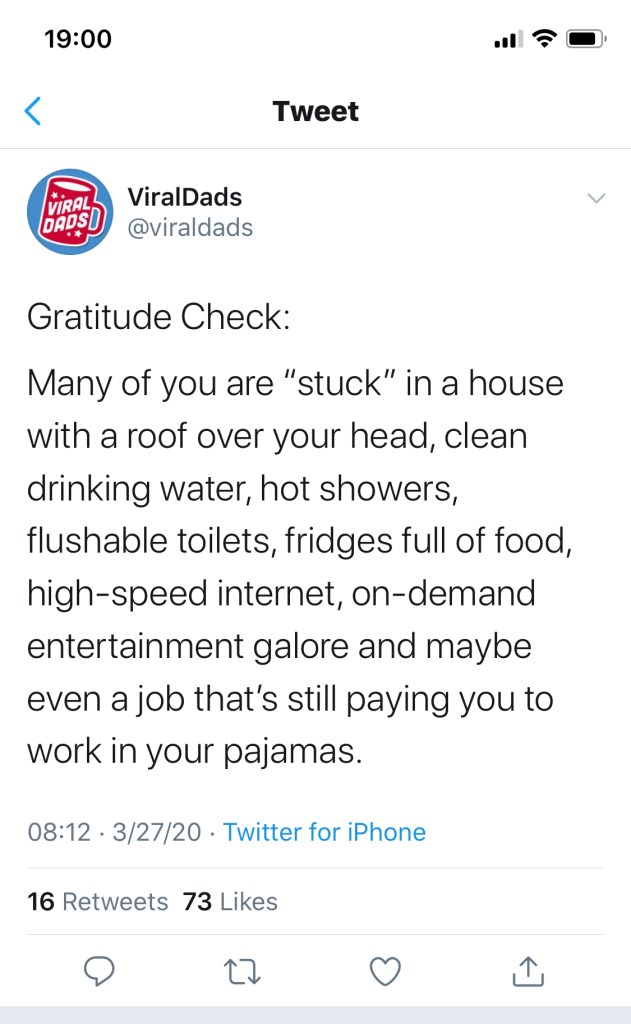
A friend came across this on Twitter today and sent it to me. It’s an account that’s supposed to be a lighthearted take on the challenges of parenting in the midst of a pandemic, and the intent of this post, I imagine, is pointed levity.
Comments like this present challenges for many of us who struggle with mental health. Let me explain.
Until I finally established a medication protocol that alleviated the worst of my symptoms, I would often not only be clinically depressed but also feeling incredibly guilty for feeling so awful when there were so many others who had it worse than me. I mean, if you consider Rohingya refugees in Bangladesh or the heartbreaking number of working poor with food insecurity right here in the US, my troubles pale in comparison.
This is unhelpful on a multitude of levels. First, clinical depression doesn’t care how relatively wonderful your life may be. I freely admit that I’m tremendously fortunate to reside in a first world country, to do work that I generally love and to be surrounded and supported by some wonderful people. That does not mitigate, however, the fact that, before I finally found the right combination of meds, my mind felt like sludge all the time, or that getting out of bed was a sheer act of will, or that despite the best of efforts – good diet, exercise, sleep, meditation, time in nature – my mood was constantly submerged.
Second, if you consider that you have it pretty good compared to others, and you feel guilty that you feel so poorly, you’re digging your hole deeper. It’s hard enough to be depressed. Feeling guilty about feeling depressed because other people are suffering more – well, you’re simply feeling bad for feeling bad, which helps neither you nor the people who are suffering more.
Third, statements like this take into no account the fact that everyone has emotions, regardless of their situation. Are some of us lucky that we’re riding out our quarantine in the relative comfort of our homes with the benefits of technology, well-stocked grocery stores and functional plumbing? Absolutely, no doubt. Does that mean we have no right to be fearful about the state of the world, or concerned about our continued well-being, or sad that we can’t hug our friends, or frustrated with the temporary limitations on our lives? No. We have every right to feel what we feel. Not allowing those emotions to exist, at least initially, can be damaging.
Our entitlement to our own feelings, however, is part of a much larger picture. Because we do inhabit a world of inequality, and there are those who suffer in many different ways, in terribly difficult situations. Allowing ourselves our own fear and frustration is important because only in acknowledging those feelings and being able to move beyond them are we able to understand the plight of others with clarity and compassion. To be compassionate to others, to be able to help in any way, we must first be compassionate ourselves.
This is all to say, regardless of who we are or where we are, all of us have probably experienced fear and grief and loneliness in these last weeks. And that’s ok. It’s ok to feel those things, and important to feel those things. Because when you fully embrace those emotions, you’re more able to process them, more able to let them evolve and soften, and more able to come to a point at which you can take the gentleness with which you faced yourself and direct that warmth to those around you.
Do you find yourself dismissive of the negative emotions that arise in you? How do you approach yourself with kindness?
My task today: do my usual run in the opposite direction. I have a couple of pretty set routes for various runs (5,6,8 and 10 miles), and I’m now challenging myself to either create new routes or reverse the ones I currently have. I think it’s important to keep the mind challenged, and to keep my runs fresh (6 backwards miles done!)
This morning my husband and I decided to do a little bit of interior designing. Well, ok, it was really just moving a rug from one room to another, but it was an attempt to change up our environment.
Laying down a rug in a rather confined and already furnished space requires some major Tetris skills, and as we were delicately tilting around a large filing cabinet, by husband dropped a corned of it on his toe. *Insert resounding expletives here*. After he calmed down, we attempted to nudge it into place again, and a lifted corner came down squarely on my toe. I screeched.
And then we started laughing uncontrollably for several minutes.
Sometimes laughter is the only appropriate response in the face of adversity; anything else would simply make the situation even worse. And so, in that spirit, I give you this.
(Disclaimer: there’s explicit language. But we’re all adults here…)
What has made you laugh these last few weeks? Is it different from what you might have found hilarious before the pandemic?
My task today: limit myself to a single glass if I’m going to have wine. The last few nights I’ve had a couple of glasses (virtual happy hour with a bunch of friends on Friday and a movie night Saturday with the husband) and it has negatively impacted my sleep. I’ll write more about alcohol, stress, depression and sleep in the next few days (I’ll let you know if I hold to my one glass rule tomorrow!)



 Coronavirus Diary: Mental Health in a strange new world